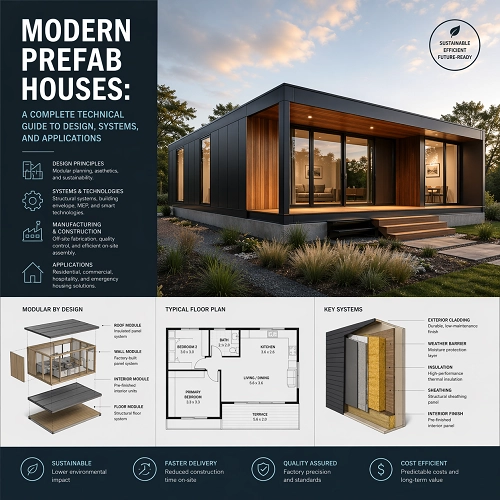
Modern prefab houses have moved well beyond their utilitarian origins. Today's factory-engineered structures combine aerospace-grade materials, precision manufacturing, and integrated smart systems to deliver residential and commercial spaces that are faster to build, cheaper to operate, and kinder to the planet than their conventionally built counterparts. This guide covers the full technical landscape — from structural typologies and material science to energy performance and global deployment scenarios.
A prefabricated building is one in which the majority of structural components — wall panels, floor cassettes, roof trusses, and integrated utilities — are manufactured in a controlled factory environment before being transported and assembled on a prepared site. The term "modern prefab house" distinguishes today's precision-engineered offerings from the rudimentary portable cabins of the mid-twentieth century.
Factory production brings with it a level of dimensional accuracy, material consistency, and quality-control oversight that is extremely difficult to replicate on an open construction site subject to weather, labour variability, and supply-chain unpredictability. The result is a structure whose performance characteristics — thermal, acoustic, structural — are known quantities before the first panel is shipped.
Modern prefab houses are not a monolithic category. Several distinct structural approaches are in commercial use, each with its own performance profile, cost characteristics, and optimal use case. The table below summarises the four main typologies currently available through Fsilon's prefabricated building range.
| Typology | Primary Frame | Typical Footprint | Best Applications | Fsilon Product Line |
|---|---|---|---|---|
| Light Steel Frame | Cold-formed galvanised steel sections (G550 grade) | 30 – 300 m² | Permanent residential, multi-storey extensions | Light Steel House / Triangle Cabin |
| Container / Expansion | ISO shipping container corten steel shell | 15 – 240 m² (stackable) | Worker camps, pop-up retail, off-grid retreats | Container House / Expansion House |
| Space Capsule / Apple Cabin | Aerospace-grade aluminium monocoque | 20 – 40 m² | Glamping, resort pods, commercial events | Space Capsule / Apple Cabin |
| Volumetric Modular | Structural steel or CLT box module | 30 – 500 m²+ (combinable) | Hotels, student accommodation, social housing | Custom engineering projects |
The HWTKH-02 represents the leading edge of compact modern prefab houses. Designed to resemble the clean lines of a contemporary consumer device, the Apple Cabin's form is immediately distinctive on any site — whether a boutique glamping resort, a lakeside commercial complex, or an urban rooftop activation.
What distinguishes the HWTKH-02 from conventional portable cabins is its entirely integrated approach. Unlike structures that require third-party contractors to install plumbing, electrical systems, and fit-out elements after delivery, this unit ships from the factory with ceiling, walls, floor, MEP (mechanical, electrical, plumbing), and smart-home layers already installed and tested. On-site work is reduced to foundation preparation, unit placement, and utility connection — a process that typically takes days, not months.
The performance of a modern prefab house is largely determined by the specification of its constituent materials. Fsilon's prefabricated interior range — sold both as part of complete building packages and as standalone fit-out components — illustrates the depth of engineering now applied to each surface and system.
| Component | Material / Construction | Key Performance Attribute | Product Page |
|---|---|---|---|
| SPC Flooring | Stone Plastic Composite (rigid core, wear layer ≥ 0.5 mm) | 100% waterproof, dimensionally stable, Class A2 fire rating | SPC Flooring → |
| Wall Panels | Multi-layer composite (fibre cement, rock-wool core, finish coat) | Thermal resistance > R-15; zero VOC off-gassing | Wall Panel → |
| Suspended Ceiling | Mineral fibre tiles on galvanised grid | NRC ≥ 0.55; moisture-resistant in 95% RH environments | Suspended Ceiling → |
| Doors | Steel-reinforced composite core, weatherstrip seal | Sound reduction ≥ 38 dB; EN 1191 cycle-tested | Door → |
| Cabinetry | E0-grade MDF carcass, UV-coated door fronts | Formaldehyde emission < 0.05 mg/m³; load-bearing shelf ≥ 80 kg | Cabinet → |
One of the most frequently overlooked performance metrics in compact prefab units is acoustic isolation. The HWTKH-02 is engineered to reduce an external ambient noise level of 90 decibels — typical of a busy street or outdoor event venue — to below 40 decibels inside the cabin. This 50 dB attenuation is achieved through a combination of mass-loaded wall assemblies, acoustic-grade door and window seals, and resilient ceiling mounting that decouples the interior shell from the structural frame.
The commercial implication is significant: a cabin deployed at a resort event with live music or a festival can still provide guests with a sleep environment comparable to a quiet suburban bedroom.
Fsilon's ESG framework sets measurable benchmarks against which its prefabricated products are evaluated. The three pillars — testing standards, continuous innovation, and sustainability standards — reflect a company that has been conducting research in prefabricated technology since its founding in 2005.
| Metric | Fsilon Performance | Conventional Building Baseline |
|---|---|---|
| Operational carbon emissions | Reduced by >40% (lifecycle) | Reference: traditionally built unit of equivalent size |
| Material recyclability at end-of-life | 97% of materials recyclable | Typically 30–50% in conventional masonry construction |
| Waterproofing service life | 10+ years (guaranteed) | Varies; typically 5–8 years without maintenance |
| Construction waste generated | Minimal (factory off-cuts only) | 15–30% of material volume wasted on-site |
| On-site construction time | Days to weeks | Months to years |
Factory production inherently reduces waste — materials are cut to precise dimensions using CNC equipment, off-cuts are collected and recycled within the production facility, and there is no weather-related spoilage of sensitive materials. When combined with the use of low-emission composites and responsibly sourced aluminium framing, the total environmental footprint of a modern prefab house can be significantly below that of a comparable site-built structure.
The versatility of modern prefab houses is one of their defining commercial advantages. The same structural and systems platform can be adapted — through interior fit-out, exterior cladding, and site configuration choices — to serve radically different end markets. The following table maps key deployment scenarios against the relevant Fsilon product category.
| Sector | Use Case | Key Requirements | Recommended Product |
|---|---|---|---|
| Tourism & Hospitality | Glamping pods, eco-resorts, boutique lodges | Distinctive aesthetics, acoustic comfort, all-terrain deployment | Apple Cabin / Space Capsule |
| Commercial Events | Pop-up retail, exhibition pavilions, conference suites | Rapid deployment, relocatability, brand customisation | HWTKH-02 Apple Cabin |
| Residential | Affordable housing, granny flats, holiday homes | Durability, full fit-out, planning compliance | Light Steel House |
| Construction & Energy | Workforce accommodation, site offices | Rapid erection, stack ability, robust specification | Container / Expansion House |
| Healthcare & Education | Temporary clinics, modular classrooms, campus housing | Hygienic surfaces, accessibility, scalability | Custom engineering |
| Humanitarian & Government | Disaster relief, emergency shelter, transitional housing | Speed of deployment, minimal foundation requirement, cost efficiency | Container House |
A key design principle at Fsilon is what the company calls "all terrain adaptation." Because the structural frame is pre-engineered to carry defined loads, and because the utility connections are designed to interface with a wide range of site conditions, Apple Cabin units have been deployed on coastal dunes, mountain plateaus, urban rooftops, and semi-arid desert sites. Foundation systems range from simple concrete pad footings to helical screw piles for challenging ground conditions — all of which can be specified in advance without requiring a conventional poured-concrete slab.
Fsilon Home Building Materials Limited Co., Ltd was established in 2005 in Haiyan, Zhejiang, China. Listed on China's A-share main board in August 2020, the company operates a 260,000 m² smart home industrial park and holds over 400 qualifications and honours. Its global partner network spans more than 160 countries, underpinned by a supply-chain platform that offers overseas clients a single point of contact for sourcing, logistics, customs clearance, on-site installation training, and after-sales support.
The company's service model — covering design assistance for overseas project drawings, product customisation, logistics, product training, construction delivery, and after-sales guarantee — is designed to reduce the risk and complexity that have historically made prefab procurement difficult for buyers outside China. Detailed product documentation and PDF specifications are available via the Media download centre, and completed project references across engineering, residential, and commercial decoration sectors can be viewed in the Projects gallery.
For compact units such as the HWTKH-02 Apple Cabin, on-site installation typically requires between one and five days, depending on site preparation, foundation type, and utility connection complexity. Larger multi-module assemblies may require two to four weeks. This compares favourably with conventional construction timelines of six to eighteen months for structures of equivalent floor area. Full FAQ guidance is available on the Fsilon website.
Yes. Fsilon's platform supports full customisation of interior configurations, surface finishes, cabinetry layouts, and smart-home technology specification. Clients working on large hospitality or commercial projects can work with Fsilon's design team to produce bespoke drawings before production commences.
The HWTKH-02's net weight of approximately five tonnes is distributed across a 28 m² footprint, producing a relatively low bearing pressure per unit area. In most standard ground conditions, a system of pre-cast concrete pads or helical screw piles is sufficient. A full geotechnical assessment is recommended for sites with complex soil profiles, steep gradients, or coastal exposure.
The standard specification includes multi-layer insulated wall panels, thermally broken window frames, and the option for underfloor heating in addition to the standard air-conditioning system. With these specifications, Apple Cabin units have been deployed and operated year-round in climates ranging from subtropical to sub-alpine.